

Amongst the beloved Yellowstone universe lies 1923– a prequel to Yellowstone (2018) and a sequel to 1883 (2021). While the first season of 1923 aired on December 18, 2022, season two just dropped yesterday. So yeah, it’s no coincidence that this cinematic depiction of Montana in the Roaring Twenties is fresh on my mind. For now, we’re not even going to think about season two on this blog post. Please stay tuned for a secondary post when then new season comes to a finale. I’ll write about. I’m sure it won’t disappoint. (The season, not my post). Maybe both? We’ll see.
1923 can be viewed on Paramount + and spans eight decently long episodes. The show was directed by Ben Richardson and written by Taylor Sheridan. As far as the cast goes, there were several big stars that joined in on this period piece; such as Harrison Ford, Helen Mirren, Jerome Flynn, and Brandon Sklenar. You can view the full cast, here. Reducing the need for over-the-top CGI, 1923 chose its filming locations thoughtfully. When our cast goes into town (Bozeman, Montana), they’re actually visiting a carefully curated set in Butte, Montana. Butte is about an hour and twenty minutes from real-life Bozeman. The city of Butte was transformed by the 1923 production team to mimic Montana life of the early 20th century. If you were to head 30 minutes or so back towards Bozeman, you’d encounter Whitehall, Montana. Some scenes were filmed here. Lastly, the Dutton Ranch itself is located in Darby, Montana at Chief Joseph Ranch. Side note: you can reserve a cabin on this property and included with this rental price is a tour of the ranch (around $2,000 per/night). Back to business. In short, most of the show was filmed in Montana, so no faux mountain-scapes were required to create this masterpiece. Furthermore, some of 1923 actually takes place in Africa, and Africa scenes were actually filmed in Africa. Yay!

If you’ve watched the other two series, Yellowstone and 1883– you may be curious where this cast lives on the Dutton family tree. We’ll talk about it. If you’ve never watched any of the series, I highly recommend watching 1883 first. That is, if you’re into watching your movies and television shows in chronological order as one should be. In 1883, we follow the journey of the first noted ancestors of the Dutton family, James and Margaret Dutton. The main star of 1923, Jacob Dutton (portrayed by Harrison Ford) is the previously unacknowledged brother of James. Jacob did not arrive onto the Dutton family ranch until after the death of James, and we don’t get to meet him until the 1923 premiere at the ripe age of 78. Much of the following Dutton family line will spawn from the ever-so-famous Spencer Dutton (portrayed by Brandon Sklenar) and his 1923 love interest. Spencer is the grandfather of Yellowstone’s John Dutton III (portrayed by Kevin Costner). I recommend taking a look at this family tree if you’re not quite picking up what I’m putting down.

What to Expect:
As always with these Past on Screen posts, you will not find an in-depth season summary here. I’m not going to plot-bomb anything. We’re here for the history and history is what we’re going to talk about. I watched this season the first time late in 2023. I just finished re-watching the season a second time, finishing my last episode this past Friday. Using my fairly gullible eye and my husband’s extremely critical eye, we questioned this historical accuracy of what we were seeing. I made a list. I researched. Now we’re here.
Delving into themes of family, power, love, culture, and survival; 1923 presents three separate story lines- the Dutton’s protecting their Yellowstone ranch and surrounding land, Teonna Rainwater and the Indian Boarding School encounter, as well as Spencer and his post-war self-recovery adventures.

The Ranch
What’s happening on Yellowstone ranch and up in the town of Bozeman are legit. There were widespread range wars, changes in law enforcement and judicial systems, prohibition protestors, speakeasies, surges in new inventions and technologies, and much more.
In the television show, when the Dutton’s ride up to town they’re taken aback by the increasing number of automobiles over the traditional travel method of horses and wagons. While the ranch is isolated and lacks electricity electricity and plumbing, salesmen on the sidewalks are promoting washer machines and fridges. Electric within the home was right around the corner. According to the National Park Service, half of all United States’ households had electric power by 1925. Likewise, according to USHistory.org, the 1920’s emulated exponential growth in automobile ownership due to Henry Ford’s introduction of an assembly line workplace. His vehicles were both accessible and more affordable than ever before.
In terms of the town Sheriff and the ongoing range wars over land and livestock ownership, going away were the days where you could shoot at first glance. Coming were the days where you were required to report incidences to local law officials and cross your fingers they take care of the problem. For the Bozeman senior citizens, this was not the preferred way and there was no issue a bullet or a hanging ‘sesh’ couldn’t solve.
And before we move onto Teonna and her storyline, let’s quickly touch on the Prohibition Era. The Prohibition occurred from 1920-1933 and as many of us know, the manufacturing, sale, and transportation of alcohol was prohibited. Naturally, many 1920 resident were far from perfect law-abiding inhabitants. Many just resorted to low-key speakeasies or private gatherings over roadside taverns and saloons to get their dose of drink. On one of the Dutton’s trips’ to town, some of the younger crowd verbalize a password in a peephole to gain entry into a bustling, hidden-away, establishment for a night of fun. This and all mentioned thus far is a fair and accurate representation of the West in the 1920’s. As promised, back to Teonna.

The School
If you’ve watched Yellowstone, the surname Rainwater may be familiar. Chief Thomas Rainwater plays the leader of the Broken Rock Reservation and serves as an adversary of sorts to John Dutton III. While it’s never outright confirmed, Teonna is assumed to be an ancestor the the well-known Yellowstone character.
Teonna Rainwater (portrayed by Aminah Nieves) also calls Broken Rock Reservation her home, or at least she did at one point. In 1923, Teonna has already been forcibly removed from her reservation and her story begins at a less-than-friendly Indian Boarding School. I won’t delve into the details of Teonna’s experiences as we cannot do so without the forbidden plot bomb, rather; I want to take a closer look at the history of these Native American Boarding schools. Some questions that came to mind: were they as awful as depicted in the show? Was cultural expression forbidden? Were the school locations always so far from home? Were schools always Catholic? Do we have statistics to represent how many Native children were registered and how many made it back home? Let’s review.
Native American boarding schools in Montana were part of a broader United States effort to assimilate indigenous children into Euro-American culture, often at the expense of their heritage and well-being. These schools, many of which were operated by religious organizations with government funding, aimed to erase Native identities through strict rules, punishment, and forced labor. Children were taken from their families, prohibited from speaking their languages, and subjected to harsh conditions and abuse.
Montana housed 16 such schools such as Cut Bank Boarding School, Saint Ignatius Mission School, Willow Creek Boarding School, and Saint Paul’s Mission, to name a few. I highly recommend visiting the Montana State Library site to view real photos of these facilities.
While not all of the schools are Catholic, the Catholic church operated more Indian boarding schools than all other religious groups combined. In 1868, President Ulysses S. Grant’s Peace Policy was implemented to improve relations with Native tribes. The policy called for corrupt Indian Agents to be replaced with Christian missionaries in an attempt to hasten cultural assimilation through religious instruction. These religious-led schooling facilities did the opposite of accomplish peace when the truth of their methods came to light.
According to 2023 article by AP News, “At least 500 children died at some of the schools, but that number is expected to reach into the thousands or tens of thousands as more research is done.” As calculated by the National Native American Boarding School Healing Coalition (NABS), “By 1926, nearly 83% of Indian school-age children were attending boarding schools. (By 1925, 60,889 children in boarding schools) Until the research is complete, we won’t know for sure how many children didn’t made it home, however, we do know that those who did survive are indicating significant trauma from their experiences.
You can review a (NABS) database of personal stories of these survivors here.
Far from Home
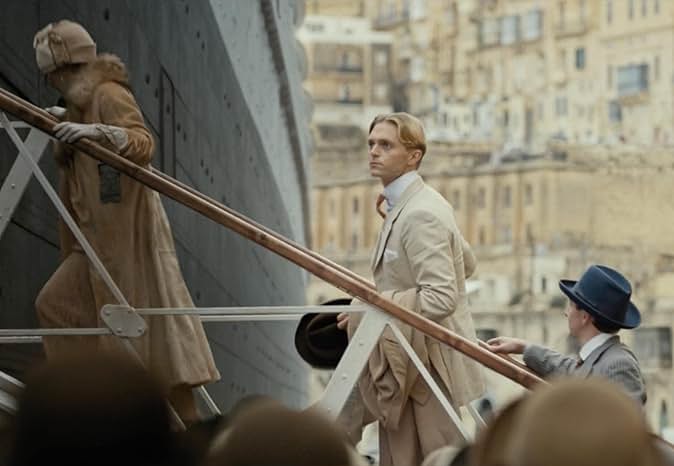
But why were some scenes filmed in Africa? Well, Spencer was feeling a bit down and out after his wartime tour in World War I. Equipped with his own traumas, Spencer transitioned to wild game hunting in Africa. As his story progresses, a journey of thrill and survival (if killing lions is not exciting enough) is embarked on. Again, not saying when and where. But let’s took a peek at what world travel was like in the 1920’s.

In the early 20th century, world travel was a unique and exciting experience, marked by significant advancements in transportation technology, changes in societal attitudes, and the rise of modern tourism. Here’s a snapshot of what world travel was like during this fascinating era:
- Ocean Liners: These luxurious vessels dominated transatlantic travel, offering comfortable accommodations, fine dining, and entertainment options.
- Air Travel: Commercial air travel was still in its infancy, but pioneering airlines like Handley Page Transport and Imperial Airways began offering scheduled flights between Europe and Asia.
- Trains: Rail Travel remained a popular mode of transportation, with iconic trains like the Orient Express and the Trans-Siberian Railway connecting Europe and Asia.
- Automobiles: As car ownership became more accessible, road trips gain popularity, especially in the United States.
Travel trends began to emerge, especially amongst the wealthy. Those with the money to spare began embarking on extended journeys to explore exotic destinations and visit lavish resorts.
Much of the travel in 1923 was among the ocean sea. A trip across the Atlantic Ocean could delay you anywhere from 5-14 days, whereas a trip from Europe to Asia could endure 4-6 weeks. Travel across the world was a multi-month experience, one that could be elongated by gaps in ship schedules, staff availability, sickness, poor weather, etc. No one was getting anywhere in hurry.
To Put it Simply:
I was not able to “debunk” any of the historical context in 1923 as being incorrect. I think it’s safe to say that some things may have been exaggerated to elicit shock and entertain viewers, but were those happenings out of the realm of possibility? Nope. Of course the characters within the television show did not actually exist- but they could have. From the sprawling ranches to the dusty small towns, the production design is meticulously researched and accurately captures the spirit of the American West during this era.
Rating:
- I’m super pleased with the casting of this television show. I think every actor and actress did an excellent job.
- Film locations and scenery are gorgeous.
- I really enjoyed the countless “Oh my goodness are they going to make it” moments. The film leaders were not afraid to remove main characters to keep you on your toes. Anyone was perishable. The suspense was a level ten throughout.
- Maximum cliff hanger warning. When you finish the finale episode you likely will not be able to wait long to switch on episode one of season two.
If you’ve watched 1923 (once or maybe twice), I want to know what you thought! Please drop your opinions and comments below and I look forward to hearing from you!


 In With The Old
Leave a reply to The Past on Screen: The Gilded Age (Season One) – In With The Old Cancel reply