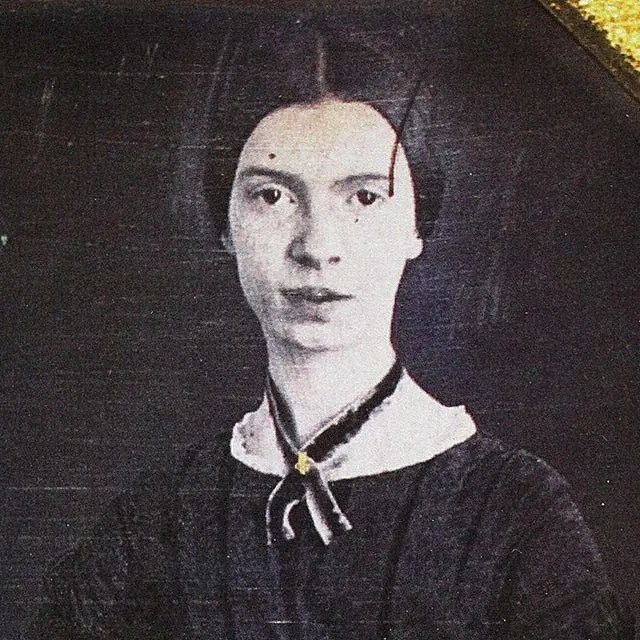
Emily Dickinson (1830-1886)
Emily Dickinson was born on December 10, 1830, in Amherst, Massachusetts. Though she wrote extensively and often enclosed poems in letters to friends, she received little public recognition during her lifetime. She died in Amherst in 1886, and the first volume of her work was years after her death.
Because I Could Not Stop for Death was written around 1863. It was published alongside a collection of other poems in the text called Poems: Series 1 that hit the shelves in 1890.
Below is her poem:
Because I could not stop for Death –
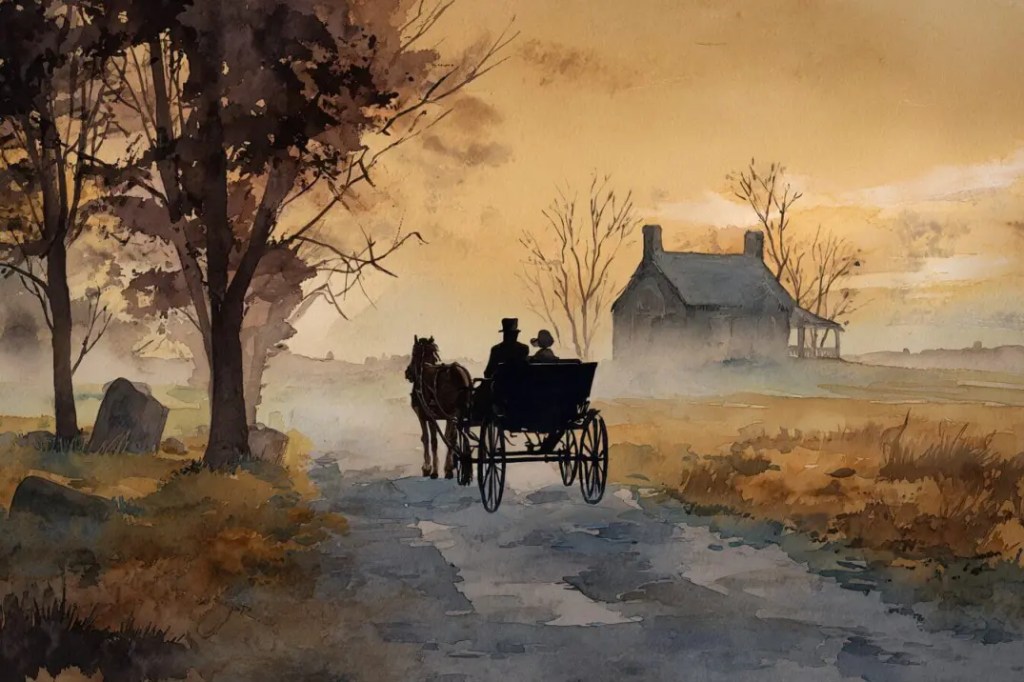
He kindly stopped for me –
The Carriage held but just Ourselves –
And Immortality.

We slowly drove – He knew no haste
And I had put away
My labor and my leisure too,
For His Civility –

We passed the School, where Children strove
At Recess – in the Ring –
We passed the Fields of Gazing Grain –
We passed the Setting Sun –

Or rather – He passed Us –
The Dews drew quivering and Chill –
For only Gossamer, my Gown –
My Tippet – only Tulle –

We paused before a House that seemed
A Swelling of the Ground –
The Roof was scarcely visible –
The Cornice – in the Ground –

Since then – 'tis Centuries – and yet
Feels shorter than the Day
I first surmised the Horses' Heads
Were toward Eternity –
Dictionary:
- Gossamer: Light, flowing fabric or natural material composed of spider-silk.
- Tippet: a long, narrow scarf or shawl, often made of delicate, translucent fabric like tulle.
- Tulle: A fine, often starched net of silk, rayon, or nylon, used especially for veils, tutus, or gowns.
- Cornice: A horizontal molded projection that crowns or completes a building or wall.
What’s it About?
The poem describes a speaker who is taken on a carriage ride by Death, who is portrayed as calm and courteous. As they travel, the speaker passes scenes from life, including children playing, fields of grain, and the setting sun. Eventually, they arrive at a house that represents the speaker’s grave. The speaker reflects that this journey happened long ago and realizes that the ride with Death marked the transition from life to eternity.
Thoughts:
In Emily Dickinson’s Poem, “Because I Could Not Stop for Death” the word stop is used in both the first line and the second line, however, both times it is used with a different connotation. She created wordplay by using two different senses of the same word. One sense refers to stop: to cease activity or operation, and the other refers to the action of making a brief call or drop in.
By intentionally using the latter definition of stop, death is characterized as human-like, portraying him as a carriage driver escorting her through the town. The speaker indicates she could not stop for death in the sense that she could not, or would not, pause her life to think about or consider death. She appears too busy, or possibly blissfully unaware of the danger or presence of mortality.
Contrary to her hurried demeanor, the entity representing death is courteous, patient and deliberate. By “kindly” stopping for her, it is implied that death is gentlemanly and not to be feared. It can be assumed that had death assumed a stereotypical hooded, lurking figure, the speaker’s behavior would have been panicked and fearful.
Because death is portrayed contradictory towards the popularized grim reaper character, a surprising tone is elicited. While the reader expects the speaker, a human, to be caught in their daily travel oblivious to their surroundings, expecting the day to be like all others, the reader does not expect death to be disguised as a polite carriage driver. When we think about death, feelings of fear, urgency or dread arise; yet in this poem, the presence of death feels unexpectedly pleasant and natural.

 In With The Old
Leave a comment