

Edgar Allan Poe was a writer central to the American Romanticism movement. He gained fame from his macabre themes of mystery, death, and psychological struggle. His mastery of atmosphere and chilling settings set him apart as a unique and influential author in literature of the 19th century. We will revisit the life of Edgar Allan Poe; from his childhood, to his early adulthood, and into his more mature years. In consequence to his own personal traumas and hurdles, his works reflect both his determination to make a living writing and the profound impact of his hardships.
Edgar Allan Poe was born on January 19th, 1809 in Boston, Massachusetts to Elizabeth “Eliza” Arnold Poe and David Poe. Both Eliza and David belonged to the entertainment industry as traveling actors. Eliza was known for her great talent and David was often referred to as having been irresponsible and incompetent. As their relationship progressed, Eliza and David had three children together. Edgar was a sibling to both a brother and a sister. After settling down in Richmond, Virginia, the family was unfortunately not united for long. When Edgar and his siblings were young, David left Eliza and the children voluntarily. Shortly thereafter, Eliza became fatally ill from Tuberculosis. She passed away at the age of twenty-four on December 12th, 1811 when Edgar was only two years old. It is believed that shortly after abandoning his family, David too passed away. What remained of the family continued to divide further as the orphaned Poe children were taken in by separate families. Unable to remain banded with his siblings, Poe was welcomed into the home of two Virginia residents in response to a newspaper advertisement posted by Eliza herself before her passing; the wealthy John and Frances Allan. Leveraging her fame, she called to her community for assistance. After a five-year stay in England from 1815 through 1820 where Poe attended an establishment called the Manor House School, the trio then returned to the United States. Poe spent the following five years enrolled in another prestigious academy until the age of sixteen. Following, he added junior honor color guard to his list of achievements. Interestingly, he was one of the young men who was privileged to escort Marquis de Lafayette on his tour. One of their stops has been transformed into a modern-day museum called The Poe Museum.
In 1826, as Poe’s teenage years were nearly concluded, he left home to attend the University of Virginia, leaving behind his foster mother and father John and Frances, but also a fiance Elmira Royster. Not long after Poe embarked on this new adventure did he soon begin to struggle financially. In an attempt to continue funding his education and provide for himself, Poe began gambling. The desperate endeavor failed and as a result he set himself back even further. He was left with no other option than to return home to the Allan household shortly thereafter. Poe’s return was not welcome. To add insult to injury, Royster had become engaged to another in Poe’s absence. With little promise of a happy future in Virginia, Poe relocated to Boston, Massachusetts.
After moving he published, “Tamerlane and Other Poems,” in 1827, and, “Al Aaraaf Tamerlane, and Minor Poems,” in 1829. At age nineteen, Poe resolved to join the United States Army, likely as a route in which he could obtain income. He did well and earned the title of Sergeant Major within a brief two-year span. In the midst of these triumphs, Poe came across a newspaper listing dated March 3, 1829, announcing the passing of his beloved foster mother, Frances Allan. It can be noted that Frances, among several other women he has met thus far, as well as the ones has not yet met, were “inextricably linked to Poe’s writing. Individually or collectively, they were the inspiration for Lenore, Annabel Lee, Helen, and arguably every other romantically-inspired female in his vast collection of stories and poems” (Young 2015). The women close to him were irreplaceable, they provided him a sense of sanctuary. The paper attributed Frances’ death to the complications of a long-term illness. Poe then returned home to participate in her processions. During this brief rapprochement with his foster father, Poe pressured John to sign paperwork he needed to ascend into the West Point Military Academy. Parallel to his experiences with the University of Virginia, Poe ran into financial shortages once more. Intentionally or unintentionally, he was accused of negligence of his duties and was ultimately dismissed. Poe published, “Poems by Edgar Allan Poe,” in 1831, before once again departing the state of Virginia.
This time, he moved to Baltimore, Maryland. He sought to unite with maternal relatives and wound up moving into his Aunt Clemm’s house, joining both his aunt and his cousin Virginia in her home. For the next few years, as he grew fond of his roommates and found comfort in his new home, Poe continued to write. He transitioned from poetry to short stories. During this time, he published two of his first pieces within the genre of horror. The Poe Museum describes them in the following manner, “Poe published “Metzengerstein” which is considered his first horror story, and “Berenice” which was so graphic and terrifying that the magazine received multiple complaints from readers.” All Poe desired was a stable income, fame, and recognition. Opportunely, the editor of a Richmond-based publication called the Southern Literary Messenger took interest in Poe’s work and offered him a position. Poe accepted, and once again moved back to Richmond. For the first time, he was not alone in the transition. His aunt and cousin joined him on the voyage.
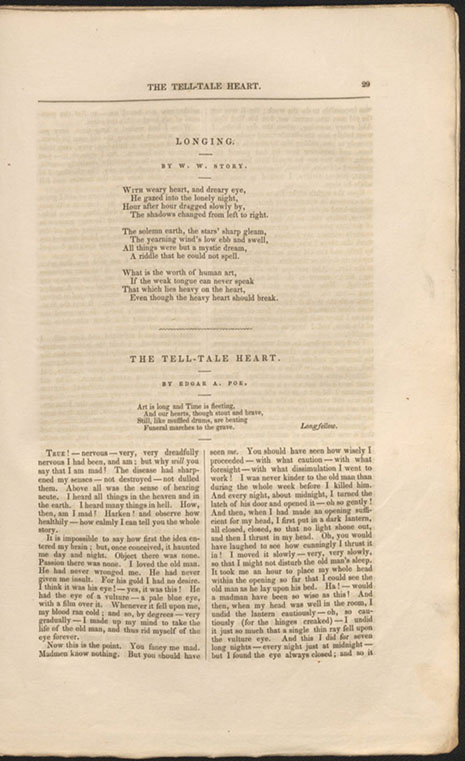
There are no records that reflect Poe’s abilities dwindled while in his new career, but his professionalism and work ethic were called into question as he developed an unfortunate habit of alcohol abuse. At the age of twenty-seven, Poe married his thirteen-year old cousin Virginia Clemm. The exact nature of their relationship is unknown. It is unclear if there was romance or just familial love and respect between the two, but nonetheless they were now bound together by law. Seemingly unable to remain in one location for too long, Poe leaves Richmond, Virginia to migrate to Philadelphia, Pennsylvania. He manufactured many of his most famous works here; “The Tell Tale Heart,” the “Masque of the Red Death,” “The Black Cat,” “The Pit and the Pendulum,” “The Gold Bug,” “The Fall of the House of Usher,” and “The Murder in the Rue Morgue.” All of these stories would ultimately go down in history as prodigious narratives, especially, “The Murder in the Rue Morgue,” which became dubbed as the first-ever detective story and an inspiration for the infamous fictional “Sherlock Holmes,” storyline that was invented years later. As his success expanded, as did his access to professional opportunities. For the next few years, Poe would waver between working at magazine editing and writing literary criticisms, quitting to then chase his dream of owning his own magazine, before then returning to another place of employment when the plan flopped. During these tumultuous years, his young wife also began to exhibit signs of sickness. Fortunately, for both Virginia and Poe, “His mother-in-law was an important source of strength to the couple during these years.” (Minor 2010) With Clemm’s fortitude, Poe was able to overcome the struggles and continue writing.
In 1845, he composed one of his most infamous works, “The Raven.” Many of his other poems and short stories had somewhat of a following, but, “The Raven,” brought Poe more fame than he had ever experienced before. Virginia’s sickness would consume her. In 1847, she too lost her life to Tuberculosis. After two years of mourning and deep introspection, Poe unveiled, “Eureka: A Prose Poem,” an unpacking of life and its origin story. Poe then returned back to Virginia, Richmond once more. He had a brief engagement thereafter with a like-minded poet, Sarah Whitman, but the two ultimately did not marry due to lack of support from the Whitman family. After Sarah, Poe reconnected with Elmira, his teenage sweetheart and ex-fiance. Elmira was now wealthy and widowed, and as such, Poe and Elmira were engaged once again in 1849. When all was well and steady, Poe initiated an out of state trip to take care of some business. He left on a steamer ship on September 26, 1849. He was next seen on October 3rd in Baltimore, Maryland. Located in a drunken state nearby a polling place, Poe was escorted and admitted to Washington College Hospital where he passed away four days later. The exact cause of his death is unknown to this day, but many theories have been presented.
Edgar Allan Poe’s entire life was inscribed with hardships that he was forced to overcome. Throughout these consistent misfortunes; loss, instability, and financial fatigue, the influential literary figure we understand Poe as today was meticulously molded. His own challenges unlocked his ability to explore human emotion like never before. Poe’s woes conferred during an era where an audience was wanting and willing to engage with literature for entertainment and open to presentations of ideologies never presented before. Poe’s skills surfaced just as there was a reader ready to read it- and as a result, Poe was inevitably titled as a key contributor of the Romantic era.

 In With The Old
Leave a comment