
Discovering America’s Military History: A Review of the American Heritage Museum
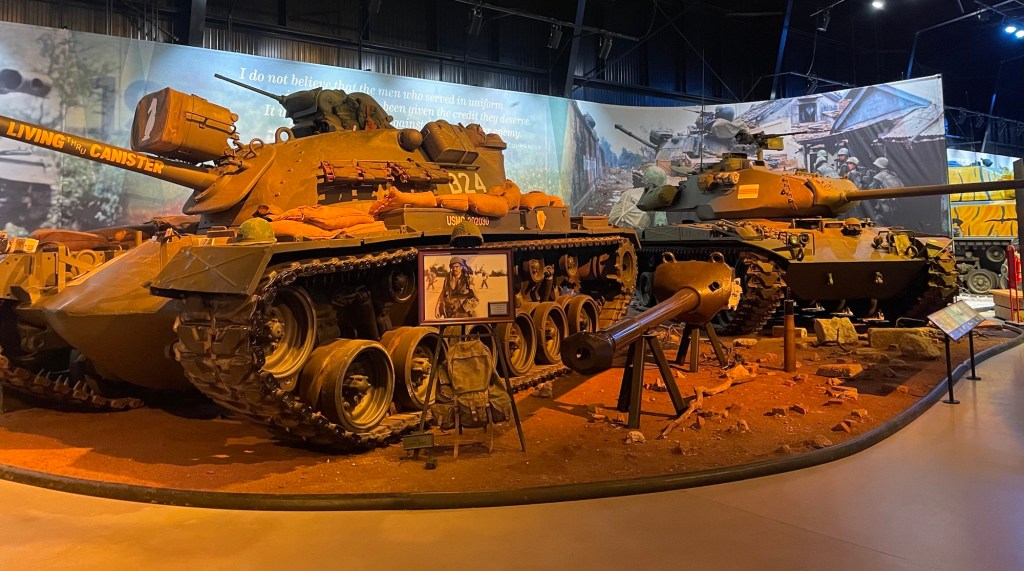
The American Heritage Museum is a treasure trove of American military history, showcasing a vast collection of artifacts, vehicles, and exhibits that bring the past to life. Located in Hudson, Massachusetts, the museum is dedicated to preserving and sharing the stories of America’s military heritage, from the Revolutionary War to the present day. As visitors step inside, they’re transported to a world of historic significance, surrounded by meticulously restored tanks, planes, and other military equipment that played pivotal roles in the shaping of our nation’s history.
The museum’s impressive collection is a testament to the dedication and expertise of its curators and restorers, who work tirelessly to ensure that each artifact is accurately restored and presented in a way that honors its history. With 66,000+ square feet of exhibits, tanks, aircraft, and other military artifacts; the American Heritage Museum offers a comprehensive look at America’s military past, highlighting the bravery, sacrifice, and ingenuity of those who served. Whether you’re a history buff, a military enthusiast, or simply looking for a unique educational experience, the museum has something to offer.
One of the standout features of the American Heritage Museum is its focus on immersive storytelling, which allows visitors to connect with history on a deeper level. Through interactive exhibits and detailed personal stories, the museum brings the past to life in a way that’s both engaging and informative. As visitors explore the museum, they’ll gain a newfound appreciation for the sacrifices made by America’s military personnel and the importance of preserving their stories for future generations. With its rich history, engaging exhibits, and commitment to preservation, the American Heritage Museum is a must-visit destination for anyone interested in American history.

Museum Details: Location, Admission, and More
The American Heritage Museum is located at 568 Main St., in Hudson, MA. When you arrive at this address, you’ll have to travel a bit down a private drive. The museum is settled fairly far from the main road.
Ticket prices vary, depending on whether you purchase them in-person, or online. There is a discount if you purchase them online and there are also other variations of free or discounted ticket(s) if you fall into certain categories. You can view their current ticket prices here.
While you can certainly visit the museum only any day they are open, it may be wise to plan ahead which day you visit if you’re interested in a tank-driving experience, or if you want to stop in during a special event.
This weekend, 7/12, the museum has a large-scale war reenactment planned. From what I can tell, there’s usually between 1-3 special events per a month. You can view the museum’s special event calendar to see if there are any upcoming that pique your interest prior to coming in. As mentioned prior, the museum offers tank experiences. While these experiences are advertised as being super pricey on their site, per the front-desk volunteers; the costs are lower during special events. However, the information on their website does not reflect this lower cost option. If you’re not swimming in cash, it may help to call the museum and get clarification.
Up Close and Personal: Tank Experiences
Alright, so yeah- I want to get in a moving tank. If even for a moment I could pretend like I was a character in Fury or T-34 without the chance of imminent death, I’d totally do it. However, when I say these prices are steep, I mean it. There’s two types of tank experiences; to drive a tank or to be a tank passenger. All tank experiences must be reserved ahead of time. Here’s their current pricing:
Rides:
– M36 Jackson Tank Destroyer (10 minute ride) – $195 per PERSON. Maximum of five (5) seated riders aboard.
– M24 Chaffee (10 minute ride) – $595 per GROUP OF THREE (3) persons – two in the turret, one in the bow gunner position.
– M4 Sherman (10 minute ride) – $595 per GROUP OF TWO (2) persons – one in the turret, one in the bow gunner position.
Driving:
– M24 Chaffee Light Tank (20 minutes driving the tank) – $995.00 donation (tax deductible)
– M4 Sherman Medium Tank (20 minutes driving the tank) – $1495.00 donation (tax deductible)
The Exhibits: A Collection of Military Might and Innovation
The exhibits centralize on America’s involvement in World War I, World War II, the Korean War, the Cold War, the Vietnam War, the Gulf War, and the Iraqi War. As you travel throughout the encouraged path of the museum, you’ll visit one or more exhibits per each battle or war. For the most part, exhibits are grouped chronologically.
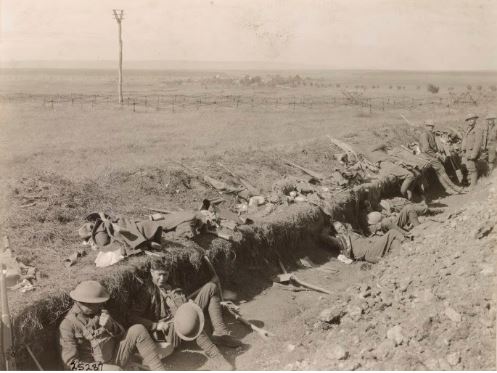




After a several minute video orientation, the real excursion begins at the World War I Trench experience, before you’re then prompted to move into the War Clouds room enclosure. This second room opens to a third room, Arsenal of Democracy, which then exits to the raised walkway that overlooks the museum floor.
The photo featured above Museum Details is one from the Trench Experience. Following up on the previous remarks about the museum mastering the art of immersion, this room is a prime example. Designed to make you feel as if you’re a soldier enduring trench warfare; between a carefully crafted set, and high-tech video and audio, this task is accomplished.
The message: World War I began in 1914 after the assassination of Archduke Franz Ferdinand by Gavrilo Princip, sparking a chain reaction of alliances: Austria-Hungary, backed by Germany, attacked Serbia, drawing in Russia, France, and Britain. The war quickly spread worldwide, with the Ottoman Empire and Bulgaria joining the Central Powers, and Italy (1915) and the U.S. (1917) joining the Allies. By its end in 1918, it had caused around 22 million deaths and led to the collapse of four empires—German, Ottoman, Austro-Hungarian, and Russian—reshaping global politics and setting the stage for World War II. The immersive WWI Trench Experience is set during the 1918 Battle of Saint-Mihiel, the first major U.S.-led offensive. It features nurse Helen Dore Boylston of Massachusetts, who served on the front lines with the British Expeditionary Force and documented her experiences in her wartime diary, later published as Sister: The War Diary of a Nurse.

War Clouds
an ominous sign of war : a threat of or a situation that threatens war.
The War Clouds and Arsenal of Democracy exhibits explore the period between World War I and World War II, focusing on the rise of Imperial Japan and Nazi Germany. It concludes dramatically with a reenactment of the 1941 attack on Pearl Harbor, which transitions visitors to the main museum floor. There, exhibits cover the Nazi rise to power, military campaigns across Europe, and Japan’s expansion into China and the Pacific. The presentation highlights how authoritarian leaders used hatred, nationalism, fascism, and racism to gain control, and how the failure of democratic governments to respond effectively in the 1930s allowed these threats to grow unchecked.
With less “theatrics” and more up-close artifacts to view, the two exhibits have a Vickers Mk. IV Light Tank, Panzer 1A Light Tank, Mercedes G4 Staff Car, a 75mm leichtes Infanteriegeschutz 18 Support Gun, and a 25mm Anti-Tank Gun, a M4A1 Sherman (Grizzly) Tank, a Sherman Turret Trainer, and my personal favorite, a 1942 Buick Super Automobile.

It’s a quite exhilarating sight, stepping out onto the Walkway. From this viewpoint you can see all the remaining tanks the museum has to offer, as well as all their other gear, turrets, vehicles and more. The open floor plan flaunts an exuberant collection of military equipment.
If I were to detail every object and exhibit- this blog post would take hours to read. Instead, I will highlight what displays I enjoyed the most. I encourage you to visit the museum’s website if you’re looking for the full inventory or what they have to offer.
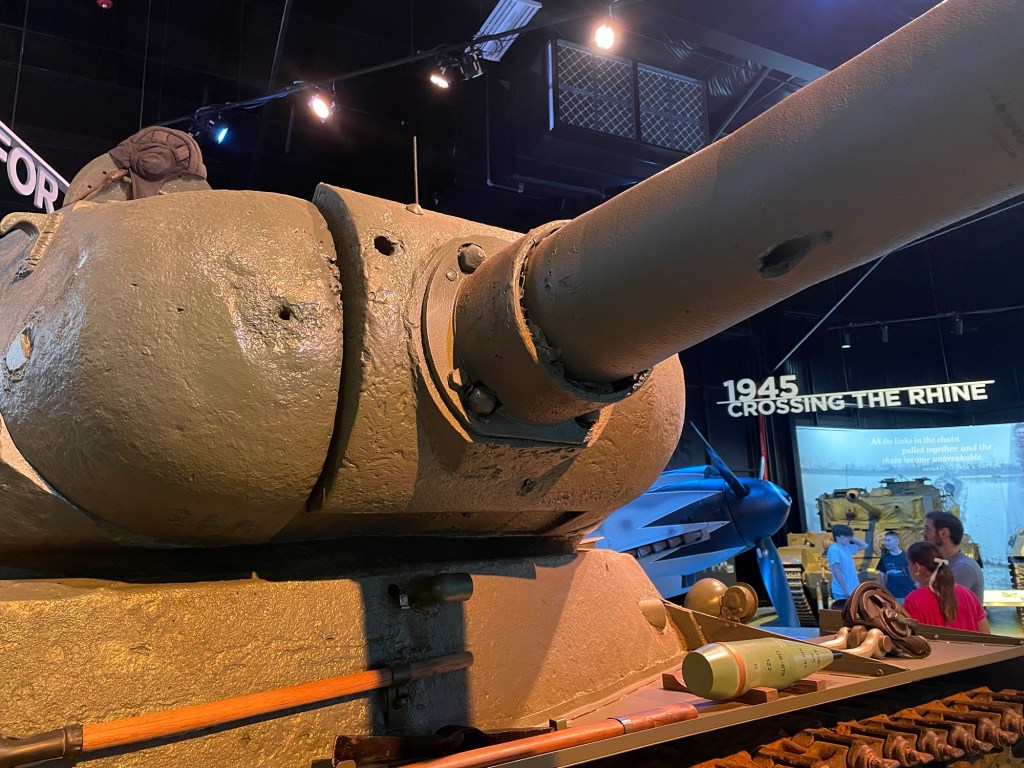
Battle for Berlin: IS-2 Josef Stalin (Heavy)
The Battle of Berlin, known to the Soviets as the Berlin Strategic Offensive Operation, was one of the final major battles in Europe during World War II. Beginning on April 16, 1945, Soviet forces launched a massive assault from multiple directions and steadily captured the city over the following week. Defending Berlin were about 45,000 German troops from weakened army and SS units, supported by police, Hitler Youth, World War I veterans, and women’s auxiliaries. As defeat became certain, Hitler died by suicide on April 30 in his Berlin bunker. The city surrendered on May 2, though fighting elsewhere in Germany continued until the war in Europe officially ended with Germany’s surrender to the Western Allies on May 8 and to the Soviets on May 9.
This tank was so cool! There was not really a distinguished boundary on this tank, we were able to get super close. So close, in fact- that we could touch (I don’t know if we are technically supposed to?) the large ammunition holes left behind by previous battles, as seen in the photo above.
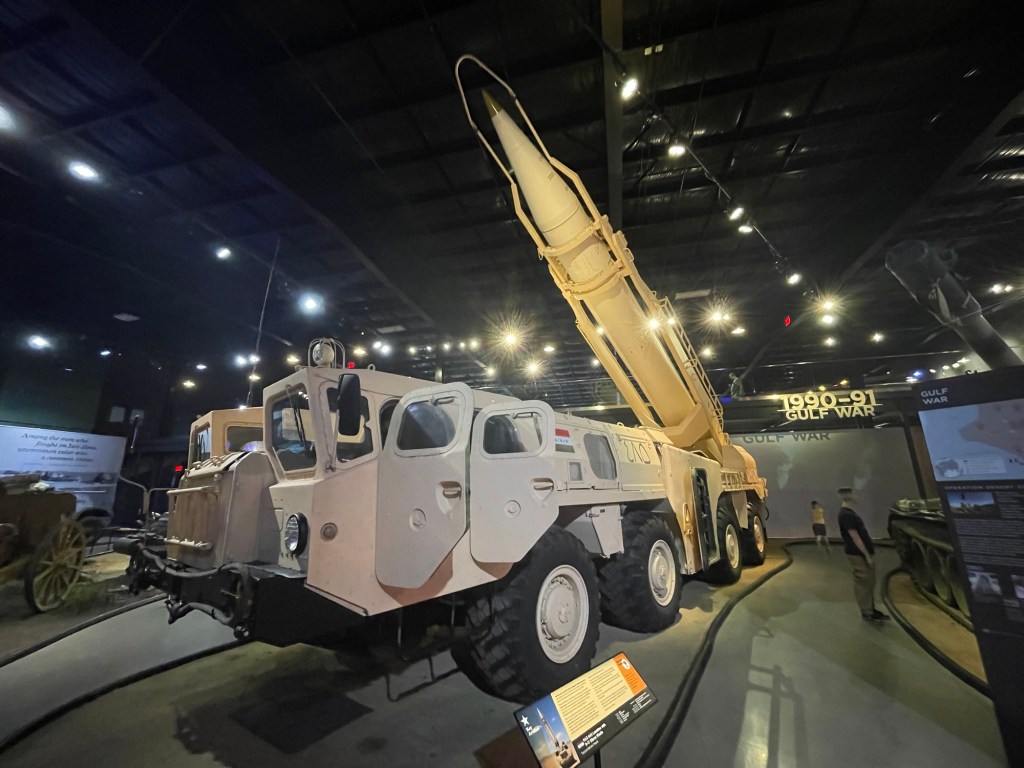
Gulf War: SS-1C Scud-B (Missile and Launcher)
Although the Iran-Iraq War ended with a ceasefire in 1988, no peace treaty had been signed by mid-1990. Hopes briefly rose during a diplomatic meeting in Geneva, but soon after, Iraqi leader Saddam Hussein accused Kuwait of stealing oil from shared fields and demanded the cancellation of $30 billion in Iraqi debt. When these demands were rejected, Hussein invaded Kuwait in August 1990. The invasion prompted outrage from neighboring Arab countries and led to international intervention. Ignoring UN demands to withdraw, Hussein faced a U.S.-led coalition that launched Operation Desert Storm in January 1991. After 42 days of intense air and ground assaults, a ceasefire was declared on February 28, with Iraqi forces expelled from Kuwait. While the war was seen as a success, ongoing tensions eventually led to the 2003 Iraq War.
I’ll admit, I am not military expert. But just seeing the sheer size of this monster, and thinking about the havoc it could reek. Mind-boggling.

Vietnam War: Hanoi Hilton Exhibit
The Hanoi Hilton exhibit at the American Heritage Museum tells the powerful story of the Hỏa Lò prison in Hanoi, infamous for the brutal treatment of American POWs during the Vietnam War. Originally built by the French in the late 1800s to house political prisoners, the prison later became a site of extreme torture, starvation, and isolation for captured U.S. airmen, despite North Vietnam’s commitment to the Geneva Convention. Nicknamed the “Hanoi Hilton” by POW Robert Shuemaker, the prison became a symbol of suffering and resilience. Notable prisoners included John McCain, Bud Day, and Everett Alvarez Jr., who spent over eight years in captivity. In the 1990s, as the site was redeveloped, original cells and artifacts were salvaged and eventually reconstructed at the museum, making it the only place in the world where these preserved prison cells can be seen. The exhibit honors the courage of those imprisoned, including Medal of Honor recipients Bud Day and James Stockdale, and stands as a powerful reminder of the sacrifices made by American POWs.
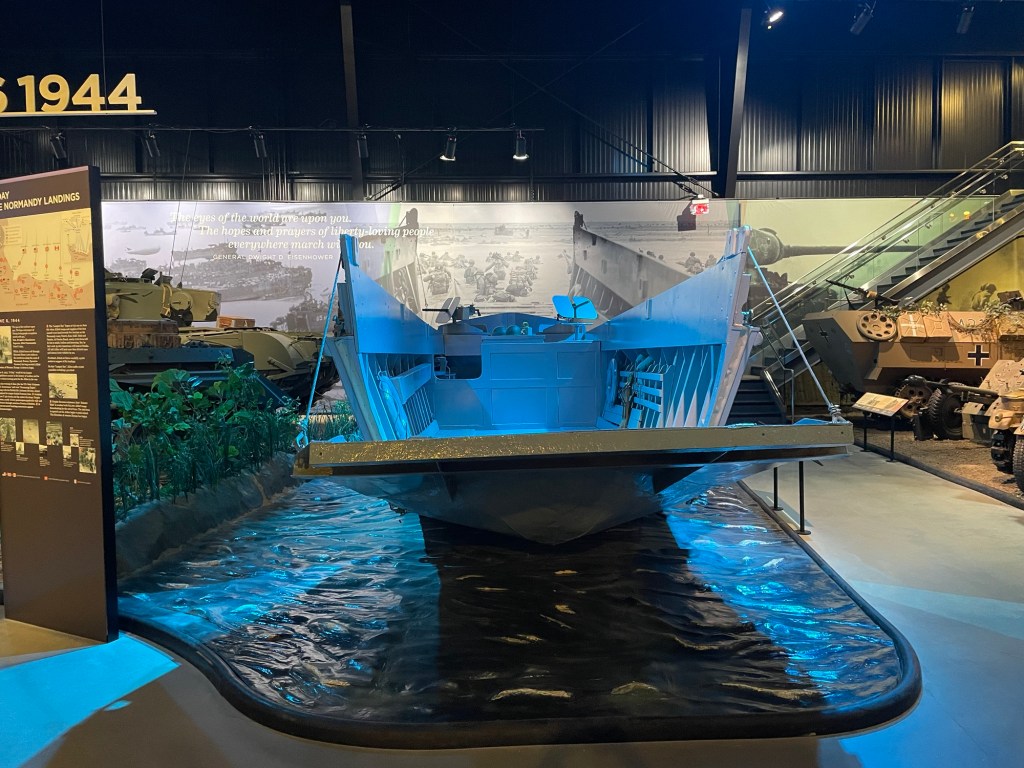
D-Day: LCVP “Higgins Boat” (Landing Craft)
Allied plans to invade Nazi-occupied Western Europe began intensifying in 1943, with Hitler tasking Erwin Rommel to fortify the Atlantic coast with a vast system of defenses known as the Atlantic Wall. On June 6, 1944—D-Day—Operation Overlord launched the largest amphibious assault in history, as 156,000 Allied troops from the U.S., Britain, Canada, Poland, and Free France landed on five beaches along the Normandy coast. The naval portion, Operation Neptune, involved nearly 7,000 vessels and 196,000 personnel from eight navies. While most beaches were secured with moderate resistance, American forces faced severe opposition at Omaha Beach, suffering over 2,000 casualties. Despite fierce fighting and thousands of Allied and German losses, the beachheads were secured by June 11, and Paris was liberated by late August. However, the war dragged on through the winter of 1944 and into 1945, with brutal fighting continuing across France, the Netherlands, and into Germany, delaying final victory until the following spring.
The LCVP (Landing Craft, Vehicle, Personnel), or Higgins Boat, played a crucial role on D-Day (June 6, 1944) by serving as the primary landing craft used to deliver Allied troops, vehicles, and supplies directly onto the heavily defended beaches of Normandy.

Holocaust: Deutsche Reichsbahn Rail Car
The centerpiece of the American Heritage Museum’s Holocaust exhibit is a restored 1903 German cattle car, imported from Nuremberg in 2023. This 30-foot, two-axle freight car is the same type used by the Nazis to deport millions of Jews and other targeted groups to concentration and extermination camps across Europe between 1933 and 1945. While individual rail cars weren’t specifically documented, the scale of the Holocaust makes it highly probable that every car of this kind was used for such purposes at some point.
Adolf Hitler, in his book Mein Kampf, promoted the false idea of a global Jewish conspiracy, and after becoming Chancellor of Germany in 1933, he quickly consolidated power, pushing a platform of nationalism, racial purity, and expansionism. The Nazis established their first concentration camp at Dachau in 1933 for political opponents, and under Heinrich Himmler’s SS, anti-Semitic policies escalated with the Nuremberg Laws (1935) and violent attacks during Kristallnacht (1938). Following the 1939 invasion of Poland, Jews were forced into ghettos and later deported to camps. As Germany expanded into Eastern Europe, mobile killing units (Einsatzgruppen) murdered over 800,000 Soviet Jews. In 1942, the Nazis implemented the “Final Solution,” building extermination camps like Auschwitz-Birkenau, where over a million were murdered. In total, about 6 million Jews—nearly two-thirds of Europe’s Jewish population—were killed in the Holocaust, along with millions of others. Survivors faced immense loss, and many later helped establish the state of Israel in 1948. After the war, top Nazi officials were captured, tried, and executed for their crimes.

Vietnam War: F-105G Thunderchief (Fighter Bomber)
The F-105G Thunderchief, a modified version of the Republic F-105 fighter-bomber used primarily for “Wild Weasel” missions during the Vietnam War, is a large, supersonic jet.
- Here are its key dimensions:
Length: 64 feet 5 inches (19.63 meters) - Wingspan: 34 feet 11 inches (10.64 meters)
- Height: 19 feet 8 inches (5.99 meters)
- Maximum Takeoff Weight: ~54,580 lbs (24,760 kg)
- Top Speed: Mach 2.08 (about 1,385 mph or 2,229 km/h at altitude)
- Crew: 2 (pilot and Electronic Warfare Officer)
The Vietnam War, also called the Second Indochina War and known in Vietnam as the Resistance War Against America, was a prolonged and deeply divisive conflict between communist North Vietnam and South Vietnam, supported mainly by the United States. Fueled by Cold War tensions between the U.S. and the Soviet Union, the war resulted in over 3 million deaths, including more than 58,000 Americans and many Vietnamese civilians. The conflict sparked intense opposition within the U.S., dividing the nation even after President Nixon began withdrawing troops in 1973. The war ended in 1975 when communist forces captured South Vietnam, leading to the country’s reunification as the Socialist Republic of Vietnam in 1976.
This one made the list because, I mean, its size. This jet took up such a big space and couldn’t help but draw everyones eyes towards it. How could to be standing so small below such a large, powerful aircraft.
Final Thoughts
Even if you’re not a military enthusiast, the American Heritage Museum offers a deeply moving and educational experience that goes beyond tanks and battles. It’s a place where history comes alive through immersive exhibits, storytelling, and powerful artifacts that connect us to the sacrifices and bravery of those who served. Walking through the museum, you gain a profound understanding of the challenges faced by American veterans, the complexity of the conflicts they fought in, and the human stories behind the uniforms. This museum invites visitors of all backgrounds to reflect on the cost of freedom and the resilience of those who defended it.
Visiting the American Heritage Museum is also an important act of respect and gratitude toward our veterans. It honors their courage, dedication, and the hardships they endured—reminding us that the freedoms we enjoy today were hard won. By learning about their experiences, we keep their legacy alive and ensure future generations understand the significance of their service. Whether through witnessing the restored tanks, walking through recreated battlefields, or exploring personal stories, the museum offers a meaningful connection to our nation’s history and the heroes who shaped it.
Stay Curious,
– Karissa Boyer

 In With The Old
Leave a comment