
The Brown Family, Their Home, and Their Role in Providence’s History

First Impressions
While I thoroughly enjoy visiting any museum that houses an array of historical objects and information, I have found that the museums I appreciate the most are house museums. House museums, like all historical museums, contain an assortment of exhibits and artifacts; however, the structure itself can be considered the grandest exhibit of all. You are stepping into an environment preserved in time. According to The Rhode Island Historical Society, the museum is, “More than a house: It is history’s home.” Located at 52 Power St, Providence RI 02906, the museum is in fact a prominent piece of history. The museum focuses to educate visitors specifically about the Brown family and their role in history, but also in a more general sense; what was daily life like in Providence, Rhode Island between 1788 and 1810? How did that experience vary for the different social classes? Throughout this blog post, I will discuss my opinions on the museum content and information, as well as the visit experience.

Upon taking the first steps onto the museum property we were immediately in awe at the elegance of the outdoor “curb appeal.” The home itself stood three stories tall, fortified with brick. We worked our way around the property in search of the main entrance, stepping up grandiose marble steps before ringing the bell to be let in. Stepping into the John Brown House Museum was an opportunity to explore the past. Inside the home, the hallway walls were embellished with rich wood furniture, grandfather clocks and original art; paintings, portraits, and historic hand-etched ink transferred maps that showed a once sparsely populated Providence. Each room was furnished, as if left untouched. There was a front hall, dining room, formal parlor, informal parlor, bedchambers, bathrooms, a “sick room,” a butler’s pantry, and a woodshed as well as two exhibit rooms with information about the Gaspee Affair and the Brown family’s involvement in the Transatlantic Slave Trade to view during our visit.
Room by Room: A Closer Look
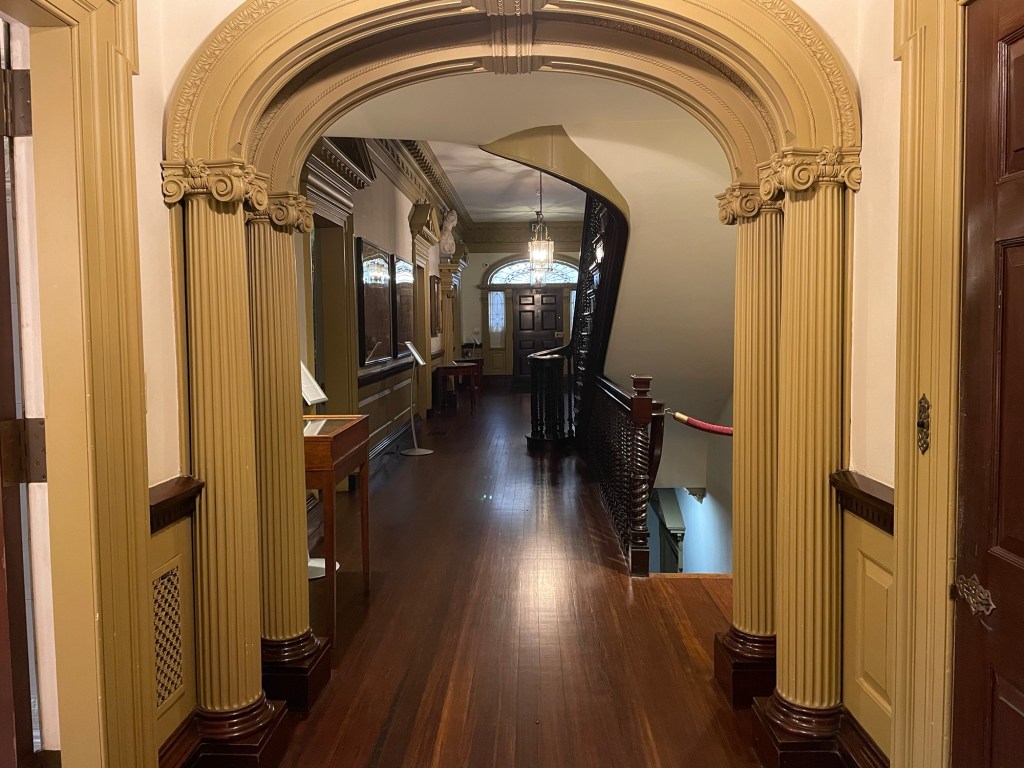
In each room contained original items belonging to the Brown and Perry family, as the home was purchased and updated by a Marsden Perry in 1901. The entirety of the home interior and exterior impressed me. Each room served as a “live” exhibit. I cannot begin to state what impressed me the most about this museum, it was not just one room or one item that stood out. Everything stood out. After crossing through the threshold of each room, all four of us found ourselves gasping in admiration at the intricacies of the space; the lavish moldings and trim, the plaster sculptures adhered to the ceilings, the hand painted tile, marble, and mahogany furnishings among much more. Just when you thought you had noticed all the elements, some other detail would catch your eye. In the formal parlor an unfamiliar gadget sat on top of a chair. Without assistance, we had little understanding of what it could be. After a discussion we learned it was an electromagnetic generator. The object served as a form, a “parlor trick”. It was extraordinary to see a piece of equipment before our eyes in such excellent condition. We wondered what that experience must have been like for the Brown family and their distinguished guests during their stays to use this generator. Just as we had made our way through the open doors of the first and second floor, we ascended to the third floor where we found an alcove that was added by Marsden Perry during his time living in the home. The alcove was wrapped in hand-tooled Italian leather wallpaper and featured a glass-encased ceiling fan used to release trapped heat out of the home in the warmer months. This combination of the combined architectural layout, technological elements, and luxurious wall coverings was remarkable. We stood below it for minutes, gazing overhead. Another space in the home we found ourselves dazed by was the woodshed. Inside was the “Washington Chariot,” a fully restored 18th century carriage that is said to have transported George and Martha Washington around Providence when they were in town.

Preserving the Past for the Future
Beyond the magnificence of the home itself and objects within, the Rhode Island Historical Society went to great lengths to transform this home into a museum. We were greeted at the door and treated with utmost kindness and respect. The museum operates as a self-guided walkthrough but as part of the experience the museum staff gives a brief overview of the house and its history before visitors begin to explore. A staff member Josh introduced us to John Brown and the subsequent owners of the home, briefly summarizing the succession. He recommended an order in which we should explore the museum and sent us on our way, checking in with us periodically to answer our questions and point out interesting features within the home. While the visit was self-guided, there were an abundance of signs explaining what each room was designed for, how it was used when it was operational, information about the Brown and Perry families, events in history and how they correlated with the families, as well as information about artifacts and architectural details in the spaces. Furthermore, each sign was concluded with thought-provoking and relevant questions to further relay the focus of the museum. For example, on the informational poster in John Brown’s shared bedchamber with his wife Sarah, it stated, “Given the intimacy of this space, what does this tell you about the relationship between enslaved people or servants with their enslavers or employers?” and on the dining room sign a question, “Do you think everyone who lived, worked, or labored here ate together at this table?” among other profound conversation topics. Moreover, there was an option to access an audio tour that accompanied visitors as they adventured. Personally, we did not use this feature but appreciated that it was available to guests. Likewise, some of the signage displayed scannable QR codes with additional audio explanations.

There were also various primary source documents directly displayed on some of the placards, sources such as ship logs and slave receipts. Another added feature of the museum that impressed us was access to a “touch” table. On it were various historically related objects such as eyeglasses and a hand carved chair leg identical to those in the exhibit available to hold and view closely. My children valued this privilege, as they love to touch everything. My five-year-old wore the glasses long enough to pose and get his picture taken. All the added features within the museum incorporated by the curators were thoughtful and contributed positively to the experience of the visit. Upon completing the tour before our departure, we had further conversation with the museum manager, Kelvis, after purchasing a trendy “Gaspee Affair” t-shirt with the infamous Led Zeppelin font above an image of the burning “Gaspee” ship. Kelvis eagerly answered any remaining questions we had about the home and pointed out a nearby feature we had missed, the glass stairs in the main hall. Overall, both staff members displayed above-average cordiality and surpassed our expectations with their knowledge of the home and Providence history.

The Gaspee Affair
As mentioned earlier, in addition to the room exhibits within the home, there were also two additional rooms representing a more traditional museum-style exhibit. One was dedicated to the Gaspee Affair and the other was called the “Sally Gallery.” Before reading the Gaspee Affair display information, my knowledge of the event was scarce. A timeline of where the affair took place amongst other more infamous pre-Revolutionary acts such as the Boston Tea Party, alongside clarifications and reflections regarding the event illuminated its importance in history. Due to John Brown’s direct involvement in the ordeal, the Historical Society gained access to an assortment of artifacts associated to the affair such as a cane that once belonged to John Brown displayed behind the glass crafted from the wood and silver plundered from the Gaspee. My understanding of the affair prior to our visit to the museum was that it was an act of rebellion against the British around the time that the Boston Tea Party unfolded due to the laws and taxes England was implementing. While interacting with the Gaspee exhibit I learned all interesting details; specifically, that it was John Brown’s ship the Hannah that maneuvered itself back to port, entrapping the Gaspee on a sandbar during low tide. In fact, I never had known that the Gaspee was grounded at all. Less interestingly, I had thought the Gaspee was just anchored near shore. When word reached town, a group gathered and plotted a plan for revenge against the ship. Once aboard, the chaos and destruction began. I had also never realized that no one was punished for this “crime.” The investigation that followed did not produce any suspects due to lack of substantial evidence and the fact that the Rhode Island Govenor at the time, Joseph Wanton, likely supported the case behind the scenes to discredit witnesses such as Aaron Briggs, who was at least half-black and described as an indentured servant.

The Slave Trade
In the “Sally Gallery,” I read the information about the Brown family’s involvement in the slave trade. While much of the information recounting the process of purchasing and selling slaves, the middle passage, and the treatment of slaves was familiar to me; there was still much I learned. For example, I had not known the unique story of the Brown family’s involvement in the slave trade. That being, John Brown’s father and uncle were the first family in Providence to sail out of Providence on a slave ship with the intent to purchase slaves across the Atlantic. Continuing the legacy of their elders, John and his brothers began to involve themselves in the business as young adults. Regardless of the danger and risks in all aspects; financial, physical, and emotional, John Brown found success in the business and became an ardent slave trader and owner. Unlike John, the other Brown brothers deemed the business too risky. One brother, Moses Brown, was horrified by the process from a moral perspective after witnessing it firsthand. Contrary to John, he dedicated his life to abolishing slavery.

Additionally, there were other aspects of the slave trade I learned by means of this gallery. In my mind, I had always envisioned that the slave ships would port in Africa and within a day or two their ship would be loaded and begin the journey back to America. It was quite the opposite when Esek Hopkins embarked on his expedition navigating the Sally. Once anchored in Africa, nine months passed before the Sally reached full capacity with enslaved and could return to Providence. While this was not a typical scenario, it was a possible one. I also did not realize that slave ship captains were incentivized with benefits, that they could bring their own slave “cargo” to sell on their own accord. I had always known that the middle passage was a horrific and potentially fatal journey for slaves but had never thought about what the experience looked like for the traders; the process of outfitting the ship, hiring a crew, navigating the sea, and the process of buying and selling slaves and goods at the port. So much could go wrong, and with the Sally it did. I would not want to be a part of that journey- above or below deck. Some of the discussion topics within the exhibit acknowledge the process of deciding what to include and exclude about the slave-trade story, as to ensure that the slave traders were not given more exhibit space due to their misdeeds, due to the way they treated the slaves. It is important to note that the museum consistently provided topics from multiple perspectives, allowing the visitor to form their own thoughts and opinions. We appreciated that this was considered and furthermore, the museum extended the challenging topic by relating it to modern-day human trafficking and the general complicity of the population to stand by without acting against it.
As mentioned, the museum elaborated on the particularly gruesome portion of the slave-trade business from multiple perspectives; detailing its difficulties for both slaves and slave-traders. What authenticated the reality of this inhumane trade for me more than any prior account was seeing the wealth of a slave-trader firsthand. Walking through the grandeur property and knowing much of what we were witnessing was a byproduct of slave sales and slave labor was gut-wrenching.
Societal Roles
The men secured an income and involved themselves in politics and war, the woman partook in the “Cult of True Womanhood,” meeting the expectations of a lady-like homemaker, and the slaves and servants took to the upkeep of the home and property. The Brown family neatly fell into these role expectations during their lives in Providence.

Final Thoughts
When reflecting on the entirety of the visit, it is unmistakable there is no room for improvement on behalf of The Rhode Island Historical Society’s John Brown House Museum. Each room in the home was meticulously kept with preserved artifacts, and when restoration was required, it depicted an accurate representation of the original appearance. Exhibit information was concise, unbiased, and meaningful, and immense detail went into procuring relevant and valuable antiquities. Guests who enter the John Brown House Musuem will exit with an informed understanding of the Brown and Perry family, their contributions to United States history, as well as what daily life was like in the 18th and 19th century for all social classes.
I encourage you to visit the dedicate site for this house museum to review their hours of operation, admission costs, and up to date information on upcoming events.
Stay Curious,
– Karissa Boyer

 In With The Old
Leave a comment